The Squeaky Floor
A developer is building a 120-unit apartment building.
Not just another apartment building.
His company has spent years developing a reputation for delivering a higher-quality product. He expects residents to notice the difference—not necessarily because they can identify every material or construction detail, but because the building should feel better.
During design, we start talking about the floor assembly.
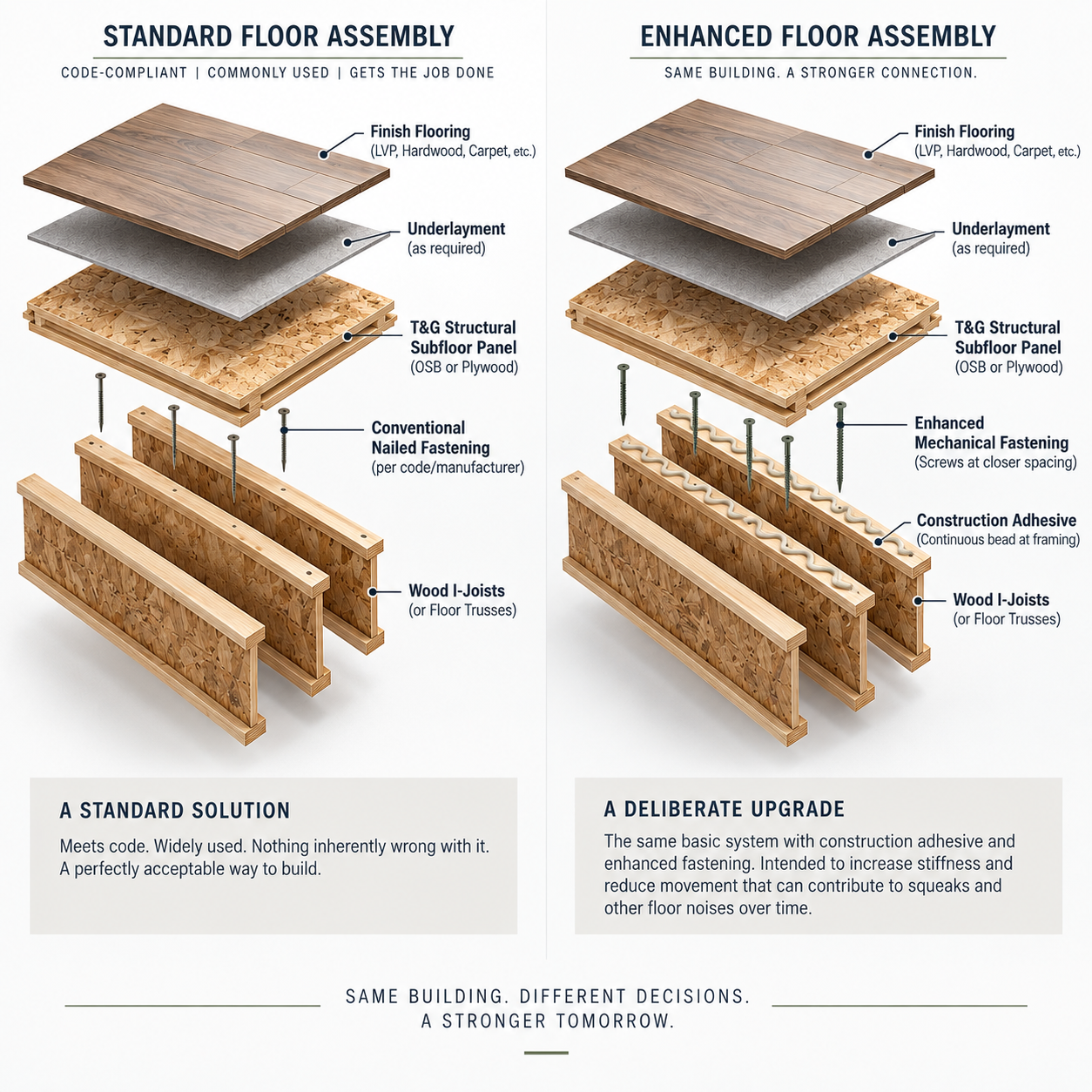
The standard system is perfectly acceptable. It meets code. It's commonly used. There is nothing inherently wrong with it.
But there is another option.
We can upgrade the subfloor installation by using a quality tongue-and-groove structural panel, construction adhesive, and enhanced mechanical fastening. The intent is to create a stiffer connection between the subfloor and framing and reduce movement that can contribute to squeaks and other floor noises over time.
It isn't a guarantee.
Buildings move. Materials change. Things happen.
There are plenty of other places a floor can develop noise, and no architect should promise that a building will never have a squeaky floor.
The question isn't whether we can eliminate the possibility.
The question is whether it's worth spending more today to reduce it.
Then We Put a Number on It.
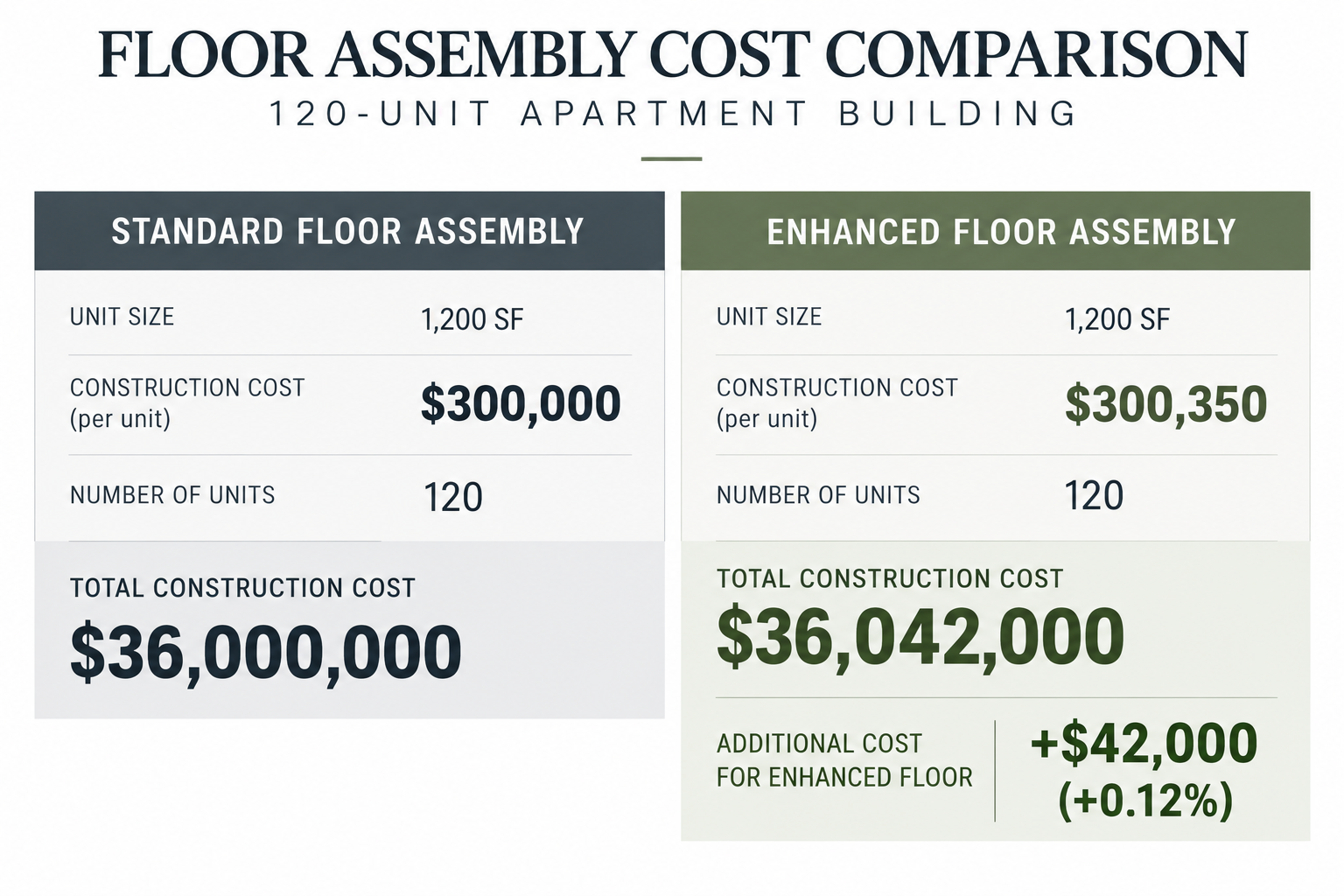
The enhanced floor assembly adds approximately $350 per apartment.
Across 120 units:
$42,000.
The developer looks at the number.
"Forty-two thousand dollars for screws and glue?"
Fair question.
"No. Forty-two thousand dollars to change how we're putting the floor system together."
The standard assembly meets code. It's commonly used. There is nothing wrong with it.
And I can't tell him that spending another $42,000 means he'll never have a squeaky floor.
It doesn't.
What I can tell him is what we're trying to accomplish.
The adhesive helps the subfloor and framing work more closely together. The enhanced fastening helps maintain that connection. Together, we're trying to increase stiffness and reduce movement—one of the conditions that can contribute to squeaks and other floor noise over time.
Then comes the question that matters.
"How long do you plan to own this building?"
He doesn't hesitate.
"A long time."
"And what are you trying to be known for?"
That takes a little longer.
Not the cheapest apartments in town.
Not luxury because somebody selected expensive countertops and put a fancy light fixture in the lobby.
Quality.
He wants someone to walk into one of his buildings ten years from now and feel like it was built well.
So now we aren't really talking about screws anymore.
We're talking about $42,000 against the purpose of a multimillion-dollar investment.
Could we save the money?
Absolutely.
Would eliminating the upgrade make this a bad building?
No.
Could the upgraded floor still develop a squeak someday?
Absolutely.
There is no promise here.
The developer looks at the number again.
$42,000.
Then he makes the decision.
"Do it."
Not because the more expensive option is automatically better.
Not because every apartment developer should build floors this way.
And certainly not because anyone promised him a problem-free building.
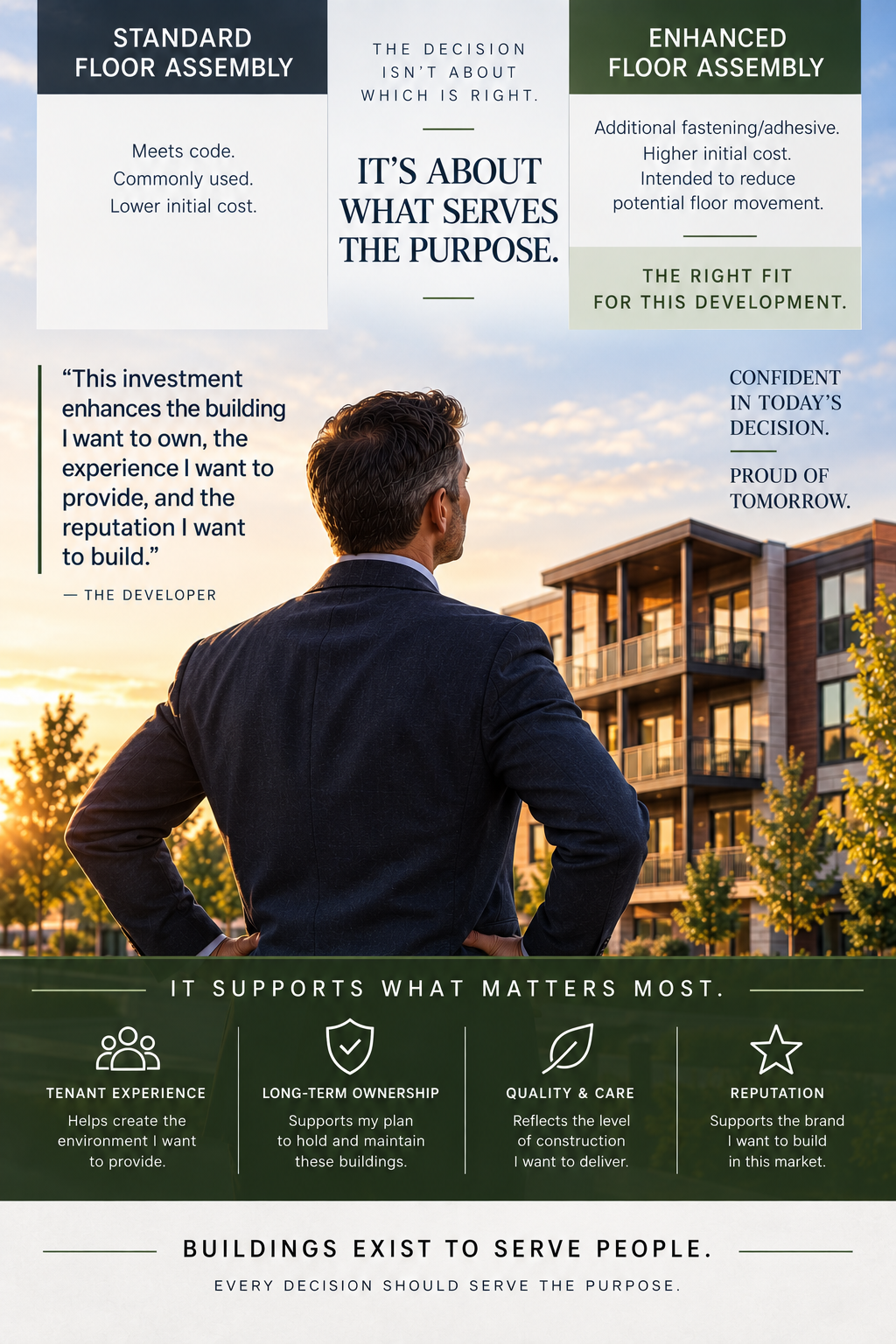
He spends the money because reducing the potential for those problems supports the reputation he's trying to build.
THAT'S THE DECISION.
Another developer could look at the exact same building, the exact same floor assembly and the exact same $42,000 and say:
"No. Put that money somewhere else."
And that doesn't necessarily make him wrong.
His purpose may be different.
That's the point.
Architecture isn't about automatically choosing the cheapest solution.
And it isn't about automatically choosing the most expensive one.
It's about understanding what the money is doing before deciding whether to spend it.
In this case, $42,000 wasn't really about screws and glue.
It was about quality.
It was about reputation.
It was about what this owner wanted his building to be—not just on opening day, but years later.
Every line on paper represents a decision.
And every decision should serve the purpose.