The Lumber Package
The $2,739.57 Decision
Value engineering is supposed to save money.
Sometimes it does.
But what happens when we save money on one piece of a building without understanding what that decision does to everything connected to it?
This particular decision started with the lumber package.
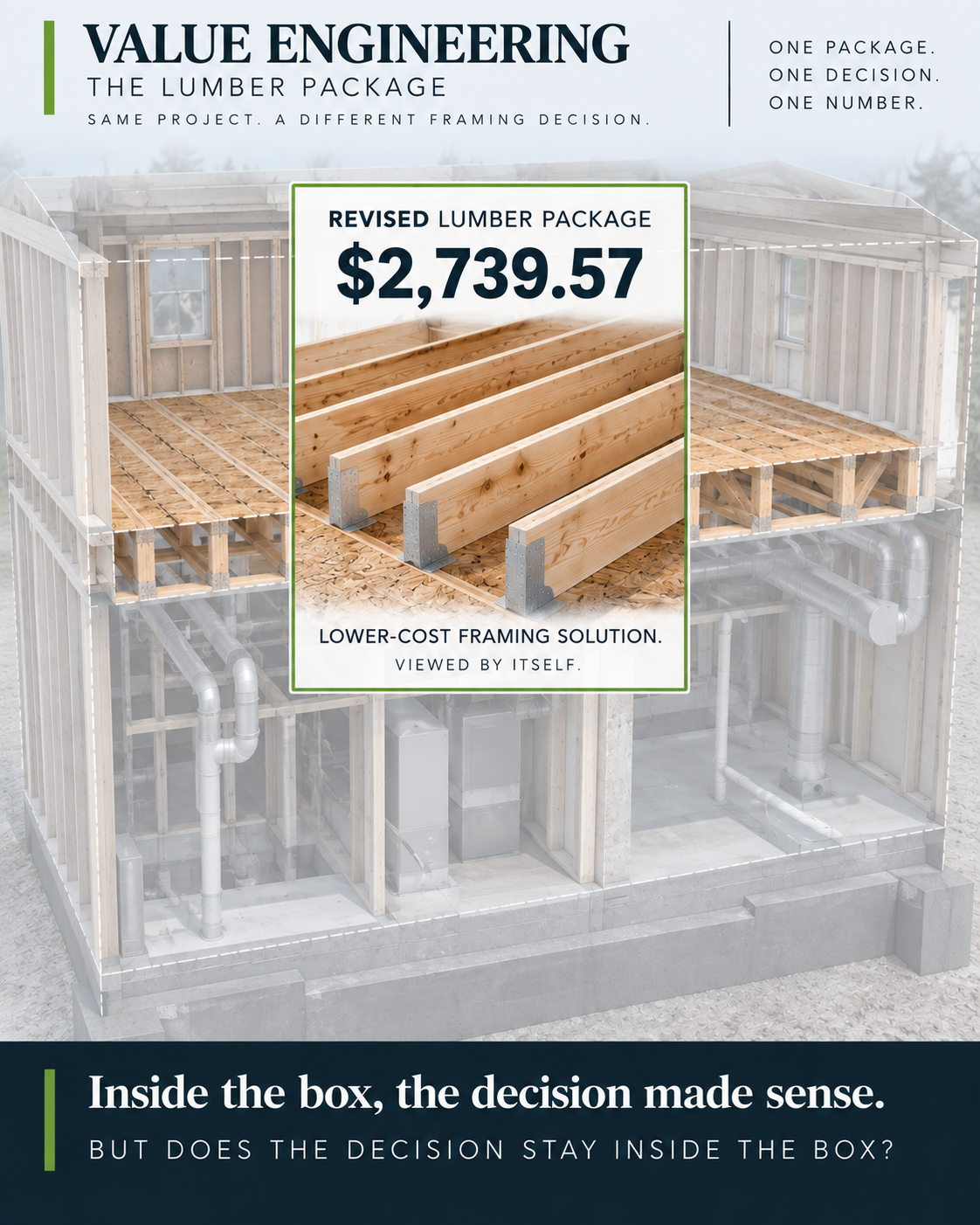
A different framing approach came back at:
$2,739.57
On paper, the number worked.
Look at the lumber package by itself, make the change, save money, move on.
Except a building doesn't work that way.
The Lumber Package Wasn't Just Lumber.
Changing the framing changed where the loads went.
And once the loads moved, other things had to move with them.
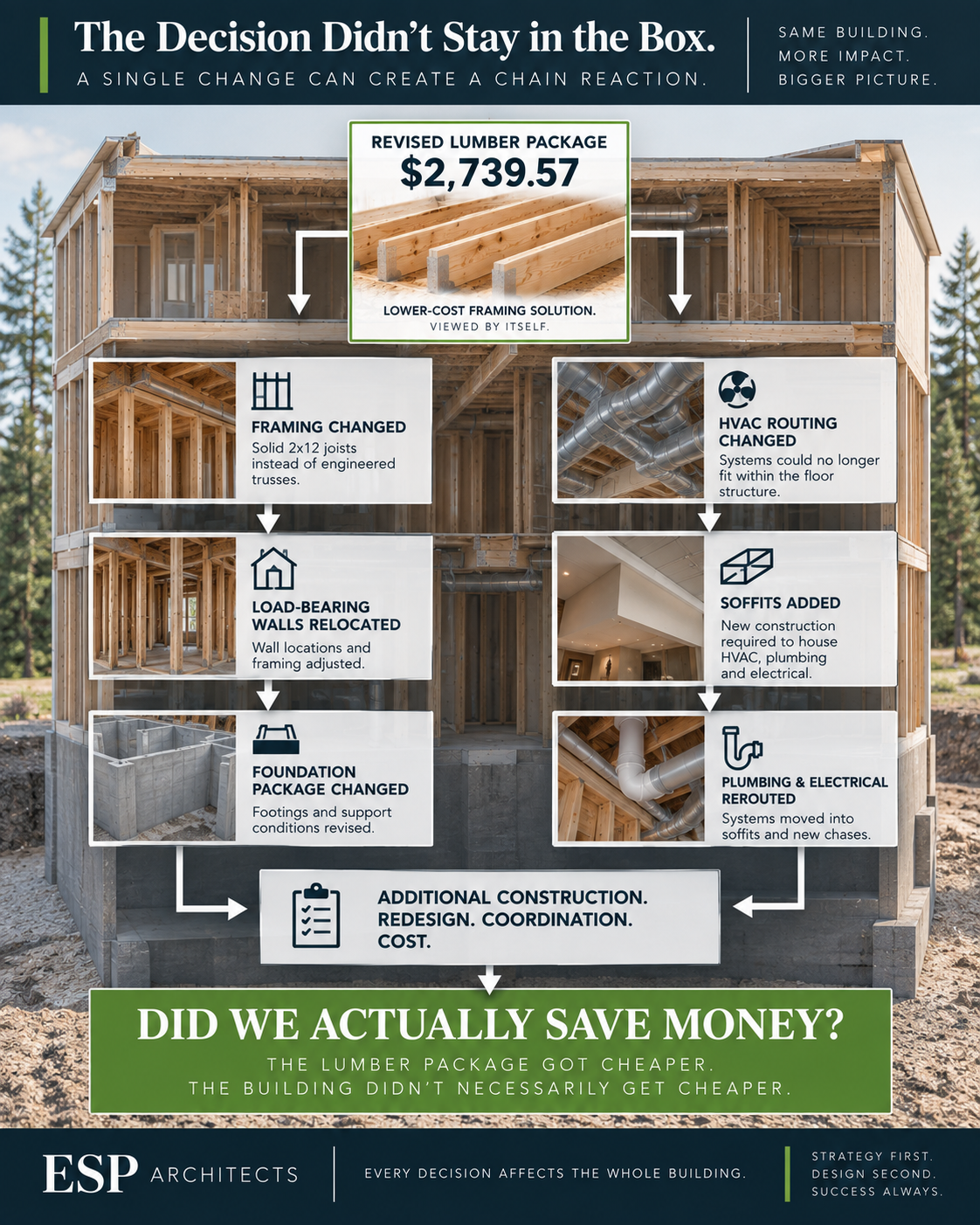
The revised framing required load-bearing walls to be relocated.
That meant the foundation package had to change to support the new load paths.
But those walls weren't sitting in empty space.
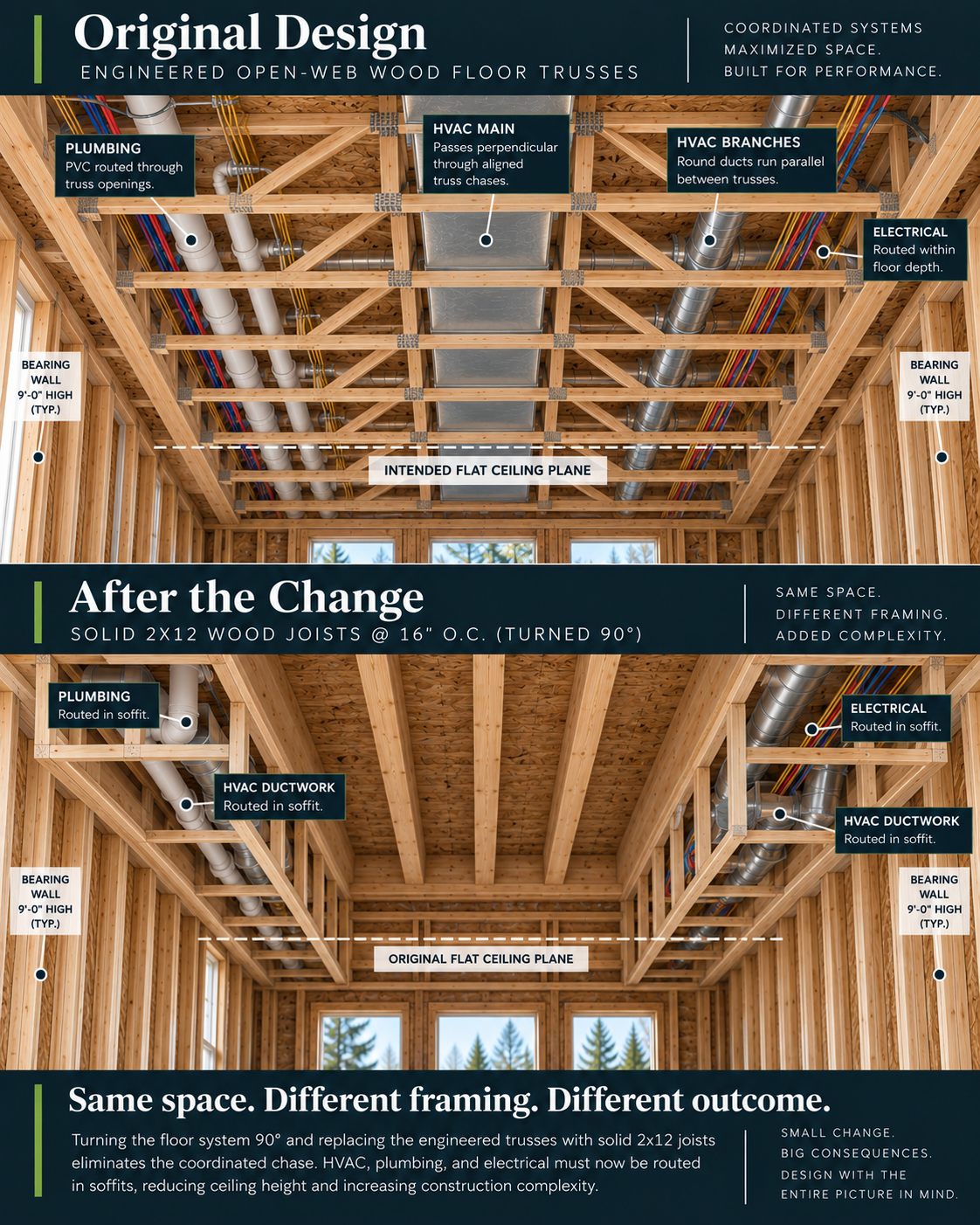
Mechanical systems had already been coordinated around the original design.
Now the HVAC routing had to change.
And because the new framing and wall locations interfered with the intended routing, portions of the mechanical system could no longer be concealed the way they had originally been designed.
So now we needed soffits.
The building wasn't supposed to have soffits.
That meant a decision intended to reduce the cost of one construction package was now affecting:
Framing → Load-bearing walls → Foundations → HVAC → Ceilings and soffits → Architecture
And every arrow represented another consequence.
Then We Put The $2,739.57 Back On The Table.
This is where the conversation changes.
We weren't really deciding whether we could reduce the lumber package to $2,739.57.
We could.
The question was:
What does saving that money actually cost?
Changing the framing wasn't free.
Changing the foundations wasn't free.
Revising the HVAC wasn't free.
Building additional soffits wasn't free.
And the time spent redesigning and coordinating those systems wasn't free either.
Suddenly, evaluating the lumber package by itself didn't tell us whether we were saving money at all.
The Little Box
This is one of the problems with traditional value engineering.
We draw a little box around something:
LUMBER PACKAGE
Then we ask:
Can we make this box cheaper?
Sometimes the answer is absolutely yes.
But the building doesn't know where we drew the box.
The structure doesn't stop at the edge of the lumber estimate.
The foundation doesn't know that we're only trying to value engineer the framing.
The ductwork doesn't care which subcontractor's proposal caused the wall to move.
Buildings are systems.
Change one part and something else may change with it.
Was The Cheaper Lumber Package Wrong?
Not necessarily.
That's important.
There was nothing inherently wrong with looking for a less expensive framing solution.
And there is nothing inherently wrong with value engineering.
The mistake is believing that reducing the price of one component automatically reduces the cost of the building.
It doesn't.
Before calling something a savings, we have to understand what that decision changes.
$2,739.57
That's a very precise number.
But precision isn't the same thing as understanding.
If saving $2,739.57 in one package creates more than $2,739.57 of changes somewhere else, we didn't save $2,739.57.
We simply moved the cost.
THAT'S THE DECISION.
Value engineering shouldn't begin with:
How do we make this cheaper?
It should begin with:
What happens if we change this?
Then we can understand the consequences.
Then we can understand the actual cost.
And then the owner can decide whether the change serves the purpose.
Every line on paper represents a decision.
And every decision should serve the purpose.